

3G & health - L1
3G is short for third-generation mobile telephony. Mobile phones and wireless devices using 3G, send and receive data much faster than second generation (2G) systems enabling many more features and applications to be possible
Compared to 2G, 3G can handle more voice calls and provides higher data communication rates and more advanced multimedia services, like video telephony and mobile broadband.
In technical terms, 3G is a generic term covering a range of wireless network standards & technologies including;
- WCDMA - Wideband Code Division Multiple Access
- UMTS - Universal Mobile Telecommunications System
- EDGE - Enhanced Data for Global Evolution
- HSPA - High Speed Packet Access including HSDPA and HSUPA
3G telephones and data communication devices emit low levels of radio waves, also known as radiofrequency electromagnetic fields, when used. These levels are below established safety guidelines.
In relation to radio frequency emissions and wireless technology and health, the general conclusion from the World Health Organization (WHO) is;
“Despite extensive research, to date there is no evidence to conclude that exposure to low level electromagnetic fields is harmful to human health”
WHO - About Electromagnetic Fields – Summary of Health Effects Key Point 6
In relation to wireless networks (including 3G) and health, the conclusion from the WHO is;
“Considering the very low exposure levels and research results collected to date, there is no convincing scientific evidence that the weak RF signals from base stations and wireless networks cause adverse health effects.”
WHO Fact sheet 304
Confirmed as current position in WHO RF and Health Presentation – ITU Workshop on EMF Turin May 2013
In 2009 and 2010, the International Commission for Non Ionizing Radiation Protection (ICNIRP) reaffirmed the EMF safety guidelines following a review of national and international EMF research and published scientific literature.
3G & Health - L2
What is 3G?
How does 3G work?
What applications and services does 3G offer?
Does 3G use more power?
What research into health effects has been done?
What do the experts say about 3G and health?
What is 3G?
3G is short for third-generation mobile telephony. Mobile phones and wireless devices using 3G, send and receive data much faster than second generation (2G) systems enabling many more features and applications to be possible.
In technical terms, 3G is a generic term covering a range of wireless network standards & technologies including;
- CDMA - Wideband Code Division Multiple Access
- CDMA2000 - Code Division Multiple Access 2000
- UMTS -Universal Mobile Telecommunications System
- EDGE - Enhanced Data for Global Evolution
- HSPA – High Speed Packet Access including HSDPA and HSUPA
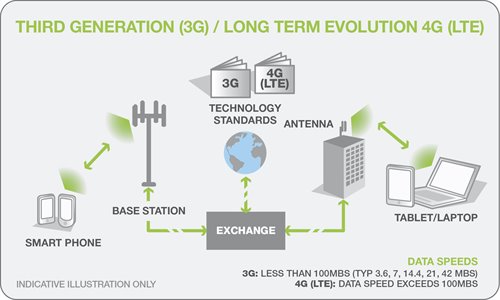
How does 3G work?
3G, or third generation networks, operate in a different way to 2G networks. When a call is made on 2G, a line is held open for the user’s conversation throughout the duration of the call. With 3G networks, the data sent across them is divided up into little ‘data packets’ which are reassembled in the correct order at the receiving end. This smart encoding means more data can be sent and it is sent more efficiently. In addition, 3G handsets can be in contact with more than one base station at a time and this provides improved performances in voice quality and data rates.
Some people call 3G “mobile broadband” because the evolution is similar to the difference between dial up internet and the always available broadband internet services.
What applications and services does 3G offer?
3G can handle more voice calls and provides higher data communication rates and more advanced multimedia services, like video telephony and mobile broadband.
Example applications and services that use 3G are;
- Voice and Video calls
- Mobile TV
- Mobile Internet
- Mobile email
- Mapping and GPS applications
- Medical monitoring and applications
Does 3G use more power?
3G mobile phones and devices are low powered and use similar power to 2G mobiles. They also automatically reduce to the lowest possible power needed to maintain a quality connection. The reason that 3G can handle more calls and higher data rates is that this newer technology uses greater bandwidth and can utilize the frequency spectrum more efficiently.
3G devices generally have more applications like web browsing, email, and video calls so they can tend to use the battery quicker. Of course this all depends on the device and battery type.
What research into health effects has been done?
Over 50 years of scientific research has already been conducted into the possible health effects from mobile phones, base stations and other wireless services including 3G.
The data from this research has been analysed by many expert review groups. Weighing the whole body of evidence, there is no evidence to convince experts that exposure below the guidelines set by the International Commission on Non-Ionizing Radiation Protection (ICNIRP) carries any health risks, for adults or children.
In 2009 and 2010, the International Commission for Non Ionizing Radiation Protection (ICNIRP) reaffirmed the EMF safety guidelines following a review of national and international EMF research and published scientific literature.
What do the experts say about 3G and health?
In relation to radio frequency emissions and wireless technology and health, the general conclusion from the World Health Organization (WHO) is;
“Despite extensive research, to date there is no evidence to conclude that exposure to low level electromagnetic fields is harmful to human health”
WHO - About Electromagnetic Fields – Summary of Health Effects Key Point 6
In relation to wireless networks (including 3G) and health, the conclusion from the WHO is;
“Considering the very low exposure levels and research results collected to date, there is no convincing scientific evidence that the weak RF signals from base stations and wireless networks cause adverse health effects.”
WHO Fact sheet 304
Confirmed as current position in WHO RF and Health Presentation – ITU Workshop on EMF Turin May 2013
On mobile phone safety the World Health Organization advise,
“A large number of studies have been performed over the last two decades to assess whether mobile phones pose a potential health risk. To date, no adverse health effects have been established as being caused by mobile phone use".
WHO Fact Sheet 193 June 2014 - Electromagnetic fields and public health: mobile phones
3G & Health - L3
Additional Information on 3G
Health Authority & Educational Resources
- RF & Health - A WHO Perspective 2013 - World Health Organization
- Summary of Health Effects - World Health Organization
- ACMA and EME Information - Australian Communications and Media Authority
Other Resources
- Mobile Technologies - GSMA
- Benefits of Mobile Broadband - AMTA video
- Mobile technology Specifications - 3GPP Mobile Broadband Standard